Description
Selling US options from Europe means you are always running a hidden position: the dollar. Your premiums, your collateral, your unrealised P&L is all in USD. Your real net worth is in euros. That mismatch is currency risk, and it runs whether you track it or not.
This article walks through how to measure the exposure at the account level, size a simple overlay using one micro futures contract, and decide honestly whether the hedge is worth the effort for your account size. Practical numbers, retail instruments, and the Python to do the arithmetic yourself.
A quick story
For years I sold options in dollars and thought in euros without giving the exchange rate a second thought. Then I actually measured it.
Look at March 2026. US equities fell hard, the S&P dropped over 4%, and the VIX spiked above 25. A painful month for anyone selling puts. But something quietly helped me: the dollar rallied to its strongest level of the year against the euro that same week. My American book was bleeding, and the currency was paying part of the medical bill.
That was the moment the currency stopped being background noise and became something I had to understand. Not to eliminate it — to control it. This is the systematic version of what I learned.
The one idea to get right: hedge the account, not the trade
Here is the mistake I did in my initial thinking of hedging. I sell a put, collect $250, and wonder whether I should hedge that $250.
Don’t do this at all! A 3% move in EUR/USD changes the euro value of $250 by about seven euros. Hedging seven euros costs more in commissions and attention than the risk itself. Trade-by-trade currency hedging is a treadmill that goes nowhere.
The real exposure is the whole account, measured in dollars. Collateral, cash, open option P&L, every dollar of it is a long-USD position. When the dollar weakens, your euro net worth falls even if your dollar P&L is green.
So the object you should hedge is the total account equity, on a planned schedule and not per trade.
Seeing the exposure in numbers
Say your account holds $30,000 in positions plus $1,500 in cash. Total exposure: $31,500, all long USD.
At EUR/USD 1.167, that’s worth €26,992 today. Now move the rate:
- Dollar weakens to 1.25 → your account is worth €25,200. You lost €1,790 without a single bad trade.
- Dollar strengthens to 1.10 → your account is worth €28,636. You gained €1,641, again with no change in your positions.
That swing is real money, and it’s driven entirely by a number you don’t control. A rough year in EUR/USD can move your euro net worth by a couple of thousand euros. Worth a look, not worth a panic.
Sizing the hedge in three lines of Python
To offset a long-USD account, you go long the euro. The cleanest retail instrument is the Micro EUR/USD future (M6E) — €12,500 of notional per contract, traded on the CME, margin around a few hundred dollars.
The question is only: how many contracts?
def hedge_contracts(equity_usd, hedge_ratio, eurusd, contract_eur=12_500):
    """Number of M6E micro-futures to hedge a USD account back to EUR."""
    return (equity_usd * hedge_ratio / eurusd) / contract_eur

hedge_contracts(31_500, 0.50, 1.167)   # -> 1.08  ->  buy 1
For a $31,500 account at a 50% hedge, the answer is one contract. You round to whole contracts, so one M6E puts you at roughly 46% hedged. Close enough — precision here is a rounding error next to your options edge.
Why 50% and not 100%? Patience — that’s the interesting part, and it comes below.
Does it actually work? Check the P&L
A hedge is only a hedge if it moves opposite to your exposure. Let’s verify with both directions.
def eur_pnl(equity_usd, contracts, entry, exit_, contract_eur=12_500):
    translation = equity_usd/exit_ - equity_usd/entry        # currency hit on the book
    fut_eur = contracts * contract_eur * (exit_ - entry) / exit_
    return translation + fut_eur                             # net EUR impact

for exit_ in (1.25, 1.10):
    print(exit_, round(eur_pnl(31_500, 1, 1.167, exit_)))
| EUR/USD move | Book (translation) | Futures P&L | Net EUR impact |
|---|---|---|---|
| Dollar weakens → 1.25 | −€1,790 | +€829 | −€961 |
| Dollar strengthens → 1.10 | +€1,641 | −€760 | +€881 |
The pattern is the whole point. The hedge removes about half the currency swing in both directions. You give up some upside if the dollar rallies, in exchange for protection when it slides. That’s what a hedge is — not a bet, a dampener.
Here it is as a picture. The steep red line is your unhedged currency risk. The flatter blue line is the same account with one micro contract on top.
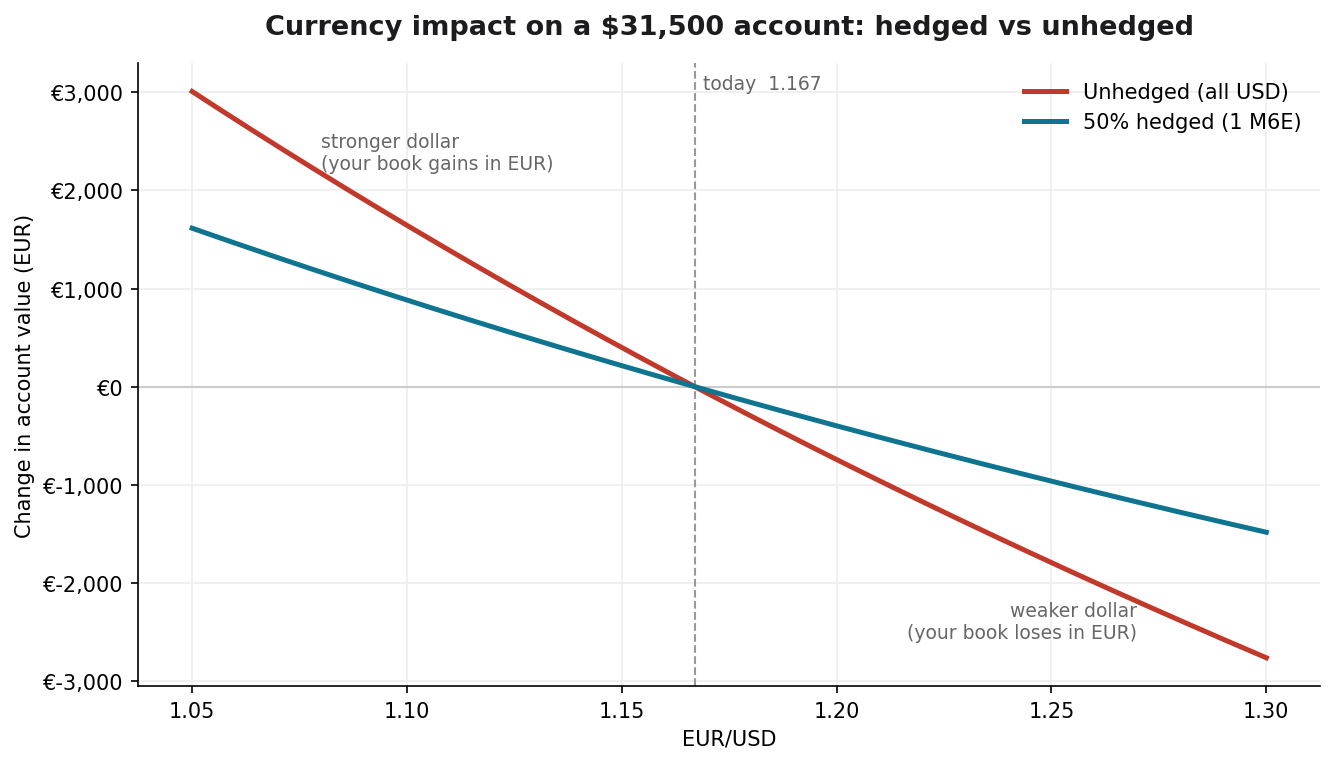
Same account, half the slope. That flattening is all you’re buying.
The hidden pattern: your dollars are already a partial hedge
Now the part most articles miss, and the reason I hold half instead of the whole.
The dollar is a safe-haven currency. When markets panic, money runs to the dollar and it strengthens. And when do you get hurt? When markets panic and your short puts go against you. Those two events line up.
So your unhedged dollar exposure quietly works as a shock absorber. In a selloff, the dollar rises and cushions your euro-denominated drawdown at exactly the moment you need it. That’s what happened to me in March 2026: equities down, dollar up, and the currency softened the blow.
A full hedge throws that cushion away. If you neutralise the currency completely, your worst months get worse in euro terms, because you’ve removed the one thing that was helping. For a trader whose book is structurally long equity risk — every put seller — a partial hedge is usually the smarter setup. You bleed off the slow, boring dollar weakness while keeping half the crisis buffer.
That’s the whole argument for 50%. It’s not a compromise. It’s a recognition that your exposure and your risk are correlated.
The cost, in one sentence
Holding long euro against higher US interest rates costs you the rate difference. Right now roughly 1.4% a year on the hedged notional, which on one micro contract is about €15 a month. It’s baked into the quarterly roll automatically. Cheap, but not zero, so factor it in.
Is it even worth it? An honest answer
Here’s where I’ll be blunt, because the systematic answer isn’t always “hedge.”
The carry and the quarterly roll are roughly fixed costs. The benefit scales with account size. That ratio is bad for small accounts and good for large ones. On a $30k book, one micro future is low effort but small money. On a $300k book, the same discipline clearly earns its keep.
So a simple decision rule:
- Under ~$50k: skip the futures. Instead, sweep your realised premium to euros every month or two. That cash isn’t collateral anyway, so converting it costs you nothing and quietly stops your dollar pile from growing. Most of the benefit, none of the maintenance.
- Above ~$50–75k, or sitting on a large idle USD cash balance: run the one-contract overlay. It’s worth the ten minutes a quarter.
- Any size, if watching a 5% FX move erase a month of premium wrecks your discipline: hedge lightly for your own sleep. That’s a legitimate reason — just be honest that it’s the reason, not the math.
The point of a systematic approach is knowing which risks deserve your attention. For most retail euro traders, currency is a second-order risk. Manage it with a second-order effort.
Final Thoughts
Currency risk is real, but it’s not the risk that will make or break you. Your edge lives in your options strategy: the timing, the sizing, the discipline. The dollar is a slow tide underneath it.
So treat it like a tide, not a storm. Measure your exposure at the account level. Hedge half of it, or just sweep premiums to euros, depending on your size. Set a schedule and stop thinking about it. And remember that in a real crisis, your dollars are often working for you — so don’t be in a hurry to hedge them all away.
Control the currency. Don’t obsess over it. Let your system do the heavy lifting.
This is the mindset behind The Quantitative Edge — simple ideas, implemented cleanly, that scale into powerful tools for data-driven trading.
Statemi bene!