Description
The Wheel Strategy has one dirty secret: the strategy itself is not where most traders fail. Stock selection is. You can execute puts and calls with perfect discipline, but if the underlying is garbage, the wheel becomes a slow-motion capital destruction machine. In this post I introduce the new Wheel Stocks page on the blog — three curated screeners that filter the entire market down to the candidates that meet the exact criteria I use in my own trading — and I show you how to use them, why each filter exists, and how the same logic looks in Python.
The Problem Nobody Talks About
Let me tell you how this page was born.
Every week I receive the same question from readers and coaching clients: “Fabio, which stocks should I use for the Wheel?” And every time, my answer starts the same way: it’s the wrong question. The right question is: which stocks should you exclude?
The Wheel Strategy works best on stocks you’d be happy to own. That sentence sounds obvious, but almost nobody trades like it’s true. Traders chase the highest premium yields — which almost always means the highest implied volatility, which almost always means the most fragile businesses. They sell a put on a meme stock for a juicy 3% monthly return, get assigned at $45, and watch the stock trade at $28 six months later. The premium didn’t disappoint. The company did.
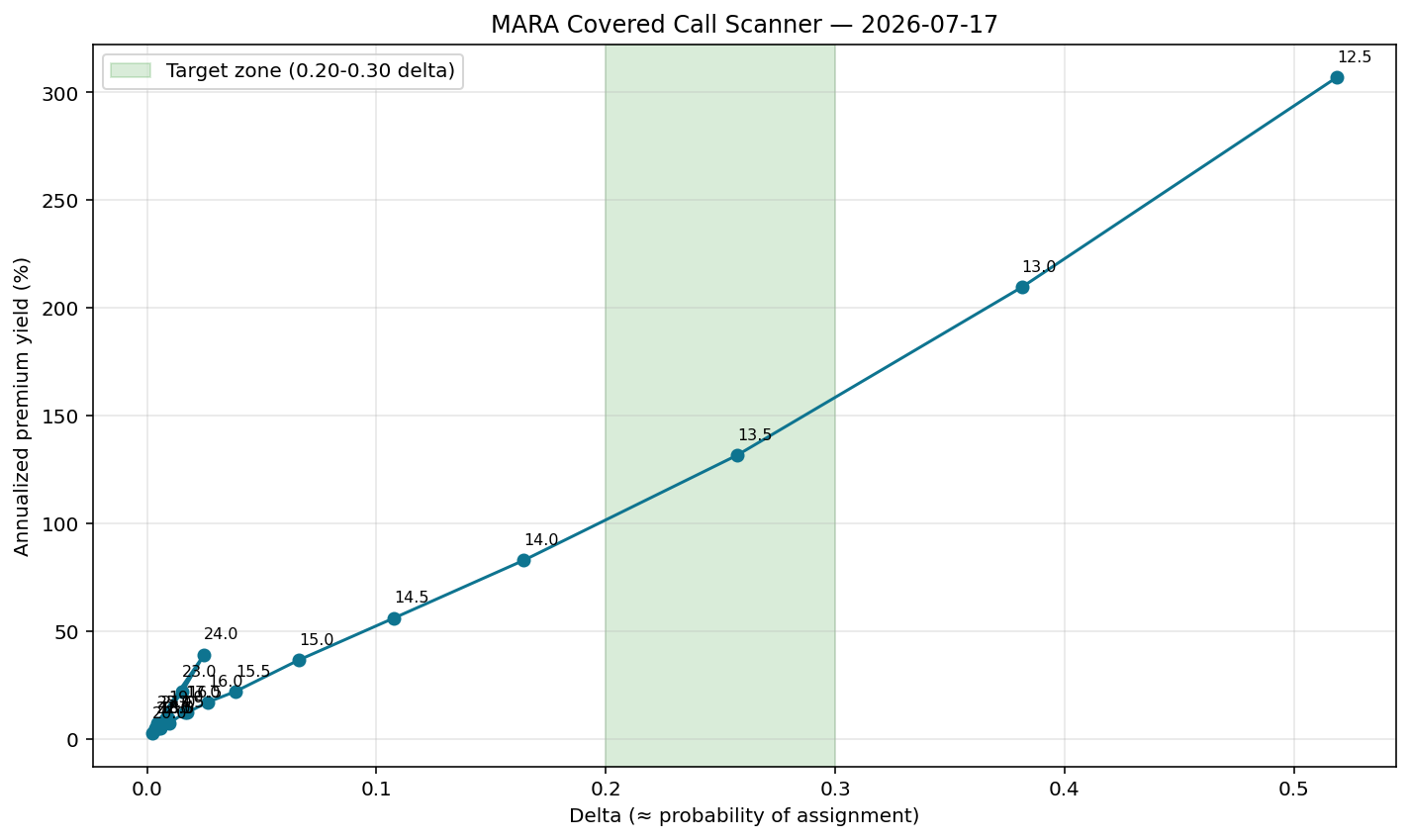
I’ve been running the wheel on my own capital for years, and you’ve followed the journey in the newsletter: the premium grind, the MARA assignment, the covered calls that slowly lower the breakeven. What made that process survivable — even during a -22% drawdown environment — was never clever option selection. It was that every underlying passed a filter before the first put was ever sold.
That filter is now public. And it’s free.
What’s on the Page
The Wheel Stocks page hosts three screeners. Each one applies a different filter set, depending on your account size, income objective, and risk profile. The lists are updated monthly, prices daily.
1. S&P 500 Wheel — The Core Watchlist
This is the default list for systematic Wheel traders. The criteria:
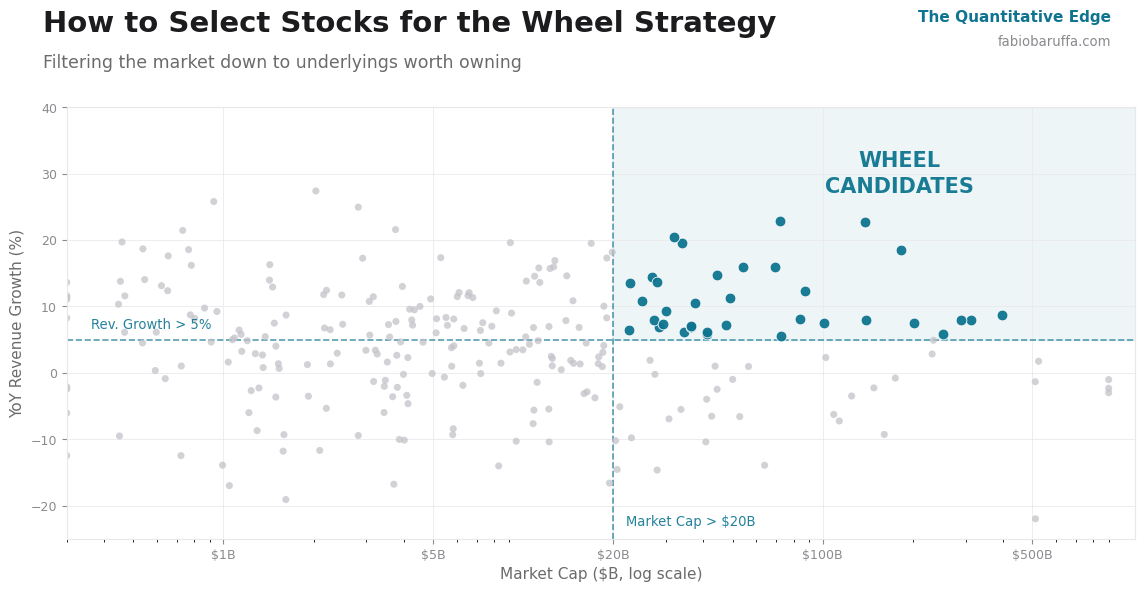
- Market Cap > $20B — large companies don’t go to zero overnight. If you get assigned, you’re holding a real business, not a lottery ticket.
- Avg. Daily Volume > 10M — liquidity in the stock translates into liquidity in the options chain. Tight bid-ask spreads are an edge you collect on every single trade.
- YoY Revenue Growth > 5% — this is the filter most wheel traders skip, and it’s the most important one. A growing business gives your assigned shares a tailwind. You’re not just harvesting premium; you’re holding something that wants to go up.
2. Small Price Wheel — For Smaller Accounts
The honest constraint of the Wheel: one cash-secured put on a $400 stock requires $40,000 in collateral. Most accounts can’t do that — and shouldn’t concentrate like that even if they could.
This screener filters for stocks priced between $10 and $50, with Market Cap > $5B and Avg. Daily Volume > 5M. Same philosophy, smaller ticket size. One contract needs $1,000–$5,000 in collateral, which means a $25,000 account can actually diversify across five or more underlyings instead of betting everything on one name.
Notice what’s not relaxed: the fundamentals. A cheap stock price is an accessibility feature, not an excuse to buy junk.
3. Dividend Aristocrats — The Double Income Engine
This one is for traders who want two income streams stacked on top of each other: option premium from the Wheel, and a growing dividend underneath.
The criteria: 20+ consecutive years of dividend growth, Dividend Growth > 2%, Market Cap > $20B. Twenty years of uninterrupted dividend increases means the company survived the dot-com crash, 2008, and the pandemic — and raised its payout through all of it. When you get assigned on one of these, holding is not a punishment. The stock pays you to wait while you sell covered calls against it.
How to Use the Screeners
Each screener is a sortable table with the columns that actually matter for wheel execution: Price, Revenue Growth, Dividend Yield, and Next Earnings.
Here is my workflow:
Step 1 — Sort by Next Earnings. This is the first thing I do, every time. Never open a new wheel position right before an earnings report. Earnings are binary events; the wheel is a probability strategy. Selling a put into earnings means your carefully calculated probability of profit is fiction. Filter out anything reporting in the next 2–3 weeks.
Step 2 — Match the list to your account. Large account, want maximum stability? S&P 500 Wheel. Account under $30K? Small Price Wheel. Building a long-term income portfolio? Dividend Aristocrats. Or use all three as a cross-reference: a stock appearing on two lists is telling you something.
Step 3 — Check the premium yourself. The screener gives you the universe. It does not give you the trade. Pull the option chain, look at the 30-delta put one expiration cycle out, and ask: is the premium worth the collateral? Sometimes a fundamentally perfect stock offers a premium so thin it’s not worth wheeling. That’s fine. The list will still be there next month.
Step 4 — Verify live quotes. Prices on the page update daily, not in real time. Always confirm with your broker before pulling the trigger.
The Same Logic in Python
If you’ve followed the blog, you know I don’t like black boxes. So here is the core screening logic, stripped to its essentials, using yfinance. This is conceptually what runs behind the S&P 500 Wheel list:
import yfinance as yf
import pandas as pd

def screen_wheel_candidate(symbol):
    t = yf.Ticker(symbol)
    info = t.info

    market_cap = info.get("marketCap", 0)
    avg_volume = info.get("averageVolume", 0)
    rev_growth = info.get("revenueGrowth", 0)  # YoY, as decimal

    passed = (
        market_cap > 20e9 and
        avg_volume > 10e6 and
        rev_growth > 0.05
    )

    return {
        "symbol": symbol,
        "market_cap_B": round(market_cap / 1e9, 1),
        "avg_volume_M": round(avg_volume / 1e6, 1),
        "rev_growth_%": round(rev_growth * 100, 1),
        "wheel_candidate": passed,
    }

symbols = ["AAPL", "KO", "MCD", "NVDA", "T"]
results = pd.DataFrame([screen_wheel_candidate(s) for s in symbols])
print(results)
Three conditions. That’s it. The edge is not in the complexity of the filter — it’s in the discipline of never trading outside it.
Run it on your own watchlist and you’ll be surprised how many “popular wheel stocks” fail at least one criterion. That’s the point. The screener’s job is to say no for you, before the market says it more expensively.
Why This Matters for Wheel Traders
Let me connect this to the bigger picture, because a screener is not just a convenience — it changes the character of the strategy.
It removes the worst decision point. The moment you’re most likely to pick a bad stock is when you’re hunting for premium. Elevated IV is seductive. A pre-filtered universe means the emotional decision (“this premium looks amazing!”) happens inside a rational boundary, not instead of one.
It makes assignment a feature, not a failure. When every candidate passed a fundamental filter, getting assigned stops being scary. You wanted to own the stock at that price. Now you do. Sell the call, collect the dividend if there is one, and keep turning the wheel.
It makes the process repeatable. Systematic trading means the same inputs produce the same decisions. A monthly-updated, criteria-based watchlist is exactly that: the same filter, applied the same way, every month. No mood. No narrative. Just data.
This is the same philosophy behind SeasonHunter, just applied to a different edge: define the criteria, let the machine scan the universe, and spend your human attention only on execution and risk management.
Final Thoughts
The Wheel Strategy is simple. That’s its strength and its trap. Because the mechanics are easy, traders assume the whole strategy is easy — and they skip the one step that determines long-term survival: choosing underlyings they’d genuinely be happy to own.
The new Wheel Stocks page does that step for you, using the same criteria I apply to my own capital: real size, real liquidity, real growth. Three lists, three risk profiles, updated monthly, free.
Bookmark it. Sort by Next Earnings. Cross-reference the lists. And remember: the screener gives you candidates, not signals. Your entry rules, position sizing, and stops are still your job.
The wheel rewards patience and punishes improvisation. Start with the right stocks, and half the battle is already won.
This is the mindset behind The Quantitative Edge — simple ideas, implemented cleanly, that scale into powerful tools for data-driven trading.
Statemi bene!
Disclaimer: This article is for educational purposes only and does not constitute financial advice. Stock screeners are research tools, not trade signals. Always do your own due diligence before trading. Options involve significant risk and are not suitable for all investors.